
Management
From Silos to Shared Solutions: Rethinking Supply Chain Resilience in Africa


As disruption becomes part of the normal operating environment, Jaimé Manuel of Unitrans considers why resilient African supply chains will depend on clearer processes, stronger partnerships and solutions designed for local realities.
For years, supply chains were judged largely by how efficiently they could move goods, reduce cost and maximise output. But in an operating environment shaped by persistent disruption, changing customer expectations and increasingly interconnected value chains, efficiency alone is no longer enough.
That was one of the clearest reflections I took from SAPICS 2026. Its theme, “Legacy to Leadership: 60 Years of Connection, Collaboration & Transformation”, invited the industry to consider not only how far supply chains have come, but what leadership now requires of us. I believe it requires a shift away from static models and isolated decisions to adaptability and collective problem-solving.

Jaimé Manuel Executive Growth at Unitrans
Disruption is now the norm for supply chains, which face infrastructure, regulatory, climate, and technological challenges. The task is not to design a system that never experiences disruption, but to build the capability to respond when conditions change.
This shifts competitive advantage, as it now depends on whether an organisation can see change early, bring the right capabilities together and adjust its operating model without compromising safety, service or control.
Stronger Supply Chains Require Clearer Roles
A recurring idea at SAPICS was the need for organisations to become more deliberate about their core competencies. Delivering an end-to-end outcome does not require one organisation to perform every component independently. It requires the lead partner to integrate the right internal expertise and specialist capabilities, establish clear accountability and keep the customer’s operational outcome at the centre.
It’s better to start by understanding where an organisation creates the most value, where specialist capability is required and how the right partners can be brought together around a defined customer need.
This is particularly important in complex African supply chains. A logistics provider, customer, technology business, equipment manufacturer and local operating team may each understand a different part of the challenge and bring a different capability to solving it. None has the complete answer in isolation. The value lies in creating an effective interface between those capabilities, supported by shared accountability and a clear outcome.
Collaboration requires greater visibility across the value chain and a willingness to share relevant information to support decisions, while protecting commercially-sensitive information.
The real test of a partnership is whether it helps solve the customer’s actual problem. A challenge that initially appears to be about transport or technology may have its roots in an inefficient process, a safety constraint, limited connectivity or an operating practice that no longer serves the customer. Listening and defining the problem correctly must come first.
Technology Cannot Repair a Broken Process
Technology was understandably prominent in many of the conversations at SAPICS, but its value depends on whether the operation is ready to use it effectively.
Before introducing another platform/application, businesses must understand and simplify the underlying process. Who performs each task? What information do they require? Where are delays/errors introduced? How will the user’s role change? What governance is needed when the system identifies an exception? Without those foundations, digitisation adds complexity instead of reducing it.
The same applies to mobile devices, which must be integrated into operations to deliver value. Human judgement remains essential. Technology can improve visibility, identify patterns and automate routine decisions, but people must interpret, manage exceptions, and ensure technology is useful.
Practical Improvement Starts at the Frontline
A Unitrans agricultural operation provides a practical example. In remote sugarcane environments, manual field inspections and connectivity constraints made it difficult to capture and share information consistently.
Unitrans worked with a specialist technology partner to digitise the existing inspection process through a custom mobile application. This meant that operational teams could record field conditions, identify hazards and make more informed decisions before vehicles entered an area.
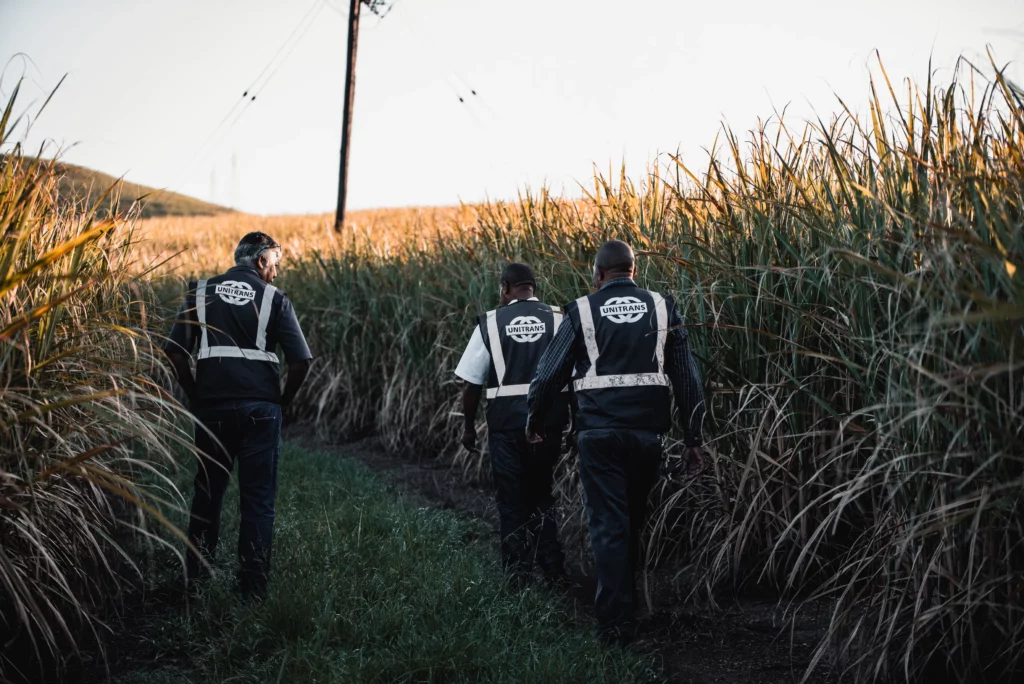
The real value was in operational knowledge, not just the app. This approach improved decision speed and safety, reducing in-field rollovers.
The example shows why adoption matters. Technology creates value when it strengthens frontline expertise rather than replacing it. When employees see that a tool helps them work more safely and effectively, compliance becomes curiosity – and operational teams begin driving improvement themselves.
Continuous improvement is rarely one dramatic intervention. More often, it comes from questioning existing practices and using data to make targeted changes.
African Solutions Must Reflect African Conditions
Common principles can be applied across a supply chain network, but implementation cannot be one-size-fits-all. African countries and operating environments differ in infrastructure, regulation, language, culture, connectivity, road conditions, skills and customer requirements. A solution that works in one market may not in another.
This requires closer collaboration with all stakeholders and a realistic view of what operations can support now and in the future. The next era of supply chain leadership will be defined by how well leaders connect people, processes, information and expertise around real operational needs.
While efficiency will remain fundamental, the supply chains best equipped to grow will be those that can adapt without losing control, share information without losing accountability, and collaborate without losing sight of their own strengths.
In practical terms, leaders must clarify the outcome, map the process, identify where specialist expertise is needed and assign someone to be accountable for each decision. Technology should then be introduced against that operating model, with frontline users involved early enough to shape how it works in practice.
The greatest opportunity lies in building collective capability to solve problems, together.

Fulfilment
Peak Season Prep Starts Now: Three Priorities for Ecommerce Companies Ahead of the Annual Code Freeze

By Melinda Ellis van Zyl,enterprise sales lead, Shiprazor
The online retailers who win Q4 are the ones who do the hard work in September. By the time November comes around, it is too late.
Most South African digital retailers lock their systems down weeks before Black Friday. A code freeze means what it says: you stop changing your site and apps so nothing breaks when traffic peaks. With the annual freeze coming up in October, now is the time to review your systems and implement fixes.
Online retail in South Africa grew 35% in 2025 to reach R130-billion, according to the 2026 World Wide Worx Online Retail in South Africa report. It is expected to grow by roughly 22.5% in 2026 to R159-billion by December, the report says.
During Black Friday 2025 online purchases by Standard Bank customers jumped 75% year on year and made up 23% of all customer spend, while Capitec clients’ online purchases surged 43%. Consumers are shopping online more; you need to ask yourself if you’re ready for them.
When you sell online without a dedicated tech or logistics team, you are competing against businesses that have both. A stress-test before the freeze helps close the customer experience gap. Here are three priorities that stand out.
1. Test the Checkout and Payment Flow Under Real Peak-Season Load, Not Average-Day Load
Your checkout is the part most likely to fall over. It may run fine on a slow Wednesday but will it hold up when a few thousand shoppers arrive at once?
Then consider that South Africa’s cart abandonment rate hit as high as 84% in 2025, much of which had nothing to do with people changing their minds. Declined card transactions alone account for roughly 52% of lost online sales, largely due to insufficient funds, expired cards, and bank-side outages that spike exactly when your volumes do.
The solution is to have a rehearsal: pretend it is Black Friday before Black Friday arrives. Place real test orders across every payment method, get several people onto the site at once, and push a batch of orders through to fulfilment. If something breaks, find it now, while you can still fix it and roll back. Once your technology freeze kicks in, it’s too late.
2. Pressure-Test the Courier Network for Redundancy, Not Just Capacity
The pressure doesn’t sit on your code alone. A single-courier setup is a single point of failure, and peak season is when it shows up. One delay, one fuel shortage, one regional gap, and every order behind it stops moving.
The obvious answer is to add couriers, but the catch is that managing them (the separate accounts, rates and tracking screens) creates its own headache when you have the least time for one.
This is where the right software earns its keep. A platform built to route parcels across several couriers carries that complexity for you, sending each order to a partner that can actually deliver it. Spreading volume across couriers from one control point keeps things moving. Set it up and test the handovers before the freeze.
3. Take the Anxiety Out of the Wait
Doubt is an understated factor that can stop a shopper. Will the package arrive as promised? What happens if it turns up damaged? These questions can fuel hesitation long before checkout. The data backs this up: two in three South African shoppers say they wish the brands they bought from kept them better informed.
Beating this doubt starts with communication. A shopper who can watch their order move, stops guessing and is less likely to message support. Automated updates by WhatsApp, SMS or email do this work for you and reassure customers who clicked ‘order’ while feeling skeptical. Pair this automation with an easy returns process and the fear of being stuck with something you don’t want fades away.
Communication and transparency give a Black Friday shopper every reason to return in December.
The Window is Closing
None of this is complicated on its own. What catches merchants out is the sequence. When the freeze happens in October, the testing, the courier audit, and the delivery fixes should all be complete. If you treat shipping as an afterthought, you’re likely to discover its weak points at the worst possible time.
Rigorously test your infrastructure, and your peak season is set to be your strongest quarter of the year. Treat logistics as one connected, end-to-end system rather than a patchwork of couriers and workarounds. This can be the difference between a business that takes the opportunity to scale and one that just survives the season.

Melinda Ellis van Zyl, Enterprise sales lead, Shiprazor

Bakers SA Limited Invests in Next-Generation Electric Fleet with 67 New Serco Bodies

SAFLA Launches Gauteng Region With Eric Pillay Appointed As Chairperson

Newlyn Advances Gqeberha Logistics Park with Second Warehouse Planned


-

 Management4 months ago
SEO, AEO, GEO and SEO for AI: What Is the Difference for the Supply Chain Industry?
-

 Transport4 months ago
LDV T60 Max vs GWM P500 vs Isuzu D-Max vs Toyota Hilux vs Ford Ranger: Which Double-Cab Bakkie Offers the Best Value?
-

 Logistics5 months ago
DHL Group to invest around € 160 million in 2026-2027 to strengthen logistics infrastructure and support clean energy transition in France
-

 Logistics4 months ago
Top 5 Warehousing and Logistics Companies in the Western Cape by Google Review Rating
-

 Logistics5 months ago
DHL Expands Asia Pacific Data Center Logistics Capabilities to Support Growing Regional Demand
-

 Logistics5 months ago
Top 10 Warehousing and Logistics Companies in Gauteng by Google Review Rating
-

 Freight Forwarding5 months ago
The Hidden Cost of Shipping from China to South Africa — What Every SA Importer Needs to Know in 2026
-

 Logistics4 months ago
Top 4 Lift Truck Companies in Gauteng