Connect with us

Management

CILTSA Women in Logistics and Transport Candidacy Programme Officially Launched 

Published

on

CILTSA event attendees

The Chartered Institute of Logistics and Transport South Africa (CILTSA), in partnership with Commerce Edge and Alto Training, officially launched the fully funded CILT Level 5: International Diploma in Logistics and Transport programme on Monday, 6 July 2026. The launch took place at the IMM Graduate School Conference Centre in Parktown and marked the start of an important professional development journey for women working in logistics, transport, warehousing, operations and supply chain environments. 

The programme, funded by the Transport Education and Training Authority (TETA), is designed to strengthen operational, management and leadership capability among women in the sector. “It offers participants access to internationally recognised learning, practical workplace-based experience, mentorship support and a professional designation pathway through CILTSA,” explains Catherine Larkin, CILTSA’s Executive Director. 

L-R: Martine Maraschin (Alto Training), Catherine Larkin CMILT (CILTSA Executive Director), Tshitshi Mholongo (TETA Road Freight Chamber) and Elvin Harris CMILT (CILTSA President)
L-R: Martine Maraschin (Alto Training), Catherine Larkin CMILT (CILTSA Executive Director), Tshitshi Mholongo (TETA Road Freight Chamber) and Elvin Harris CMILT (CILTSA President) 

The launch was well attended, with 10 Gauteng-based candidates participating in person and additional candidates joining online from across the country, including the Western Cape, KwaZulu-Natal and the Eastern Cape. Three mentors also attended the session in person, demonstrating the strong support structure that will underpin the learning journey.  

Representatives from TETA were present, reinforcing the funder’s commitment to skills development, transformation and the advancement of women in the logistics and transport industry. 

Commerce Edge, the programme provider, will deliver the learning components of the qualification, while Alto Training serves as the project management company responsible for coordinating and supporting programme implementation and TETA processes. Together with CILTSA, these partners will help ensure that candidates are guided through a structured programme that combines online contact learning sessions, workplace experiential learning, practical assignments, logbook completion, coaching and evidence gathering. 

Gauteng based candidates who attended the launch on 6 July 2026 at Commerce Edge offices in Parktown. 
Standing L-R: Tshimangandzo Mphaphathi (HOD Logistics Pricing, National Inventory and Export, DSV Healthcare), Anneshni Marimuthu (Transport Operations Manager Bidvest International Logistics), Vuyiswa Matshaya (Senior Operations Supervisor: DSV Contract Logistics) , Yolisa Sindile (Area Operations Manager Transnet Freight Rail), Dayashnee Govender (Supply Chain Team Lead: Centurion Systems), Phumzile Sibeko (Receiving Manager: The Spar Group), Tshegofatso Gololo (Forwarding Coordinator: Contract Forwarding) 
Front L-R:  Shantelly Jiyane (Rail & infrastructure Logistics Specialist: Thungela Resources), Mary-Jane Barendse (Procurement & Logistics Coordinator: Nology), Christel Lupton (Export, Pricing & Inventory Manager: DSV) 
 
Others who are part of the programme but not attended in person (from outside Gauteng): Letitia Sibusisiwe Langeni (Inland First Mile Agent: Maersk Line KZN), Nomfundo Amanda Nene (Imports Client Controller: Bidvest International Logistics KZN), Ntombenhle Nzimande (Logistics Manager : South African Sugar Association KZN) and Siphokazi Magazi (Operations Controller: Bidvest International Logistics Eastern Cape)

Running from July 2026 to July 2027, the programme covers key areas including Management in Logistics and Transport, Supply Chain Management, Transport Operations and Warehousing. Through these internationally recognised units, candidates will build practical knowledge and leadership competence that can be applied directly in the workplace. 

“The launch highlighted the value of collaboration between professional bodies, funders, training providers, employers and mentors in creating meaningful opportunities for women,” concludes Larkin. “As the candidates begin their learning journey, the programme stands as a significant investment in professional growth, industry transformation and the development of future leaders in logistics and transport.” 

Investing in women. Developing industry. Building the future. 

Frans Mothutse (Mentor) and Dayashnee Govender - Centurion Systems  posing by the CILTSA event poster
Frans Mothutse (Mentor) and Dayashnee Govender – Centurion Systems 
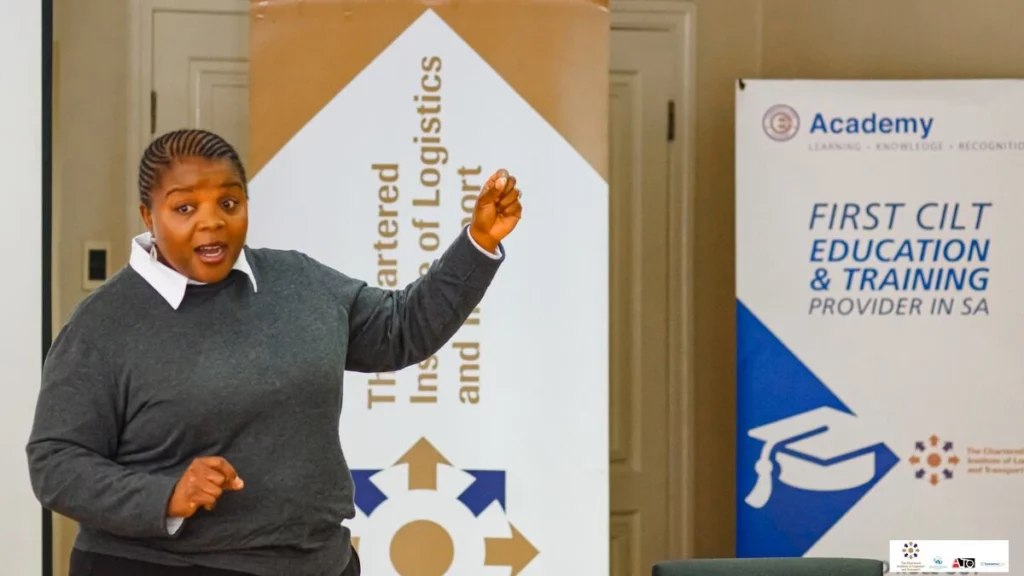
Guest Speaker and CILTSA Alumni - Nobantu Mqulwana MILT  presenting at a CILTSA event
Guest Speaker and CILTSA Alumni – Nobantu Mqulwana MILT
Phumzile Sibeko (Candidate) and Thato Letsoalo: The Spar Group posing beside a CILTSA event poster
Phumzile Sibeko (Candidate) and Thato Letsoalo: The Spar Group 
Yolisa Silinga (Candidate) and Moloko Matjekane (Mentor) Transnet Freight Rail  pose beside a CILTSA banner poster
Yolisa Silinga (Candidate) and Moloko Matjekane (Mentor) Transnet Freight Rail 

Management

How the Best Supply Chain Leaders Think Differently

Published

on

Supply chain leader on a business call in front of her laptop.

Supply chain leadership has never been a simple job. Leaders are expected to balance cost, efficiency, customer expectations, supplier relationships, technology, people and an increasingly unpredictable global environment.

What has changed is the speed and complexity at which those challenges can emerge.

A disruption that once seemed like an isolated event can quickly affect suppliers, transport networks, inventory levels and customers across an entire operation. At the same time, businesses are under pressure to adopt new technologies, improve efficiency and respond to changing customer expectations.

In this environment, being a good supply chain leader is not only about knowing how a supply chain operates. It is about thinking differently about the challenges facing it.

They Look Beyond the Immediate Problem

Supply chain leaders spend a great deal of time solving problems. A delayed shipment needs attention. A supplier cannot fulfil an order. Inventory is running low. A customer needs an urgent delivery.

These issues cannot simply be ignored, but the strongest leaders do not stop at fixing the immediate problem.

They look at what the problem might be telling them about the wider supply chain.

A recurring delay could point to a weakness in a particular route or supplier relationship. Unexpected fluctuations in demand could reveal weaknesses in forecasting. A stock shortage might expose a lack of flexibility elsewhere in the network.

This means good leadership is not just about asking, “How do we fix this?” It is also about asking, “Why did this happen, and what can we change so that we are better prepared next time?”

That shift in thinking can turn individual problems into opportunities to strengthen the wider operation.

They Are Comfortable With Uncertainty

There will always be things that supply chain leaders cannot control.

Markets change. Costs fluctuate. Customers change their behaviour. Suppliers experience their own challenges. Transport networks can be disrupted by events thousands of kilometres away.

Trying to predict every possible disruption is unrealistic.

Instead, strong leaders think about how prepared the organisation is to respond when something unexpected happens.

This can mean having alternative suppliers, maintaining relationships across a broader network, understanding where the most important dependencies exist or simply ensuring that decision-makers have enough visibility to react quickly.

The goal is not to eliminate uncertainty. It is to make the supply chain less vulnerable to it.

They Don’t Chase Technology for Technology’s Sake

Artificial intelligence, automation, robotics, predictive analytics and other technologies are changing the way supply chains operate.

For leaders, however, the question should not simply be which technology to adopt next.

The more important question is what problem the technology is supposed to solve.

Technology can improve visibility, automate repetitive tasks, support forecasting and help businesses make decisions faster. But introducing a new system does not automatically make a supply chain better.

The strongest leaders understand this distinction. They consider how technology fits into the wider operation, whether their teams can effectively use it and whether it is solving a meaningful business problem.

In other words, they start with the supply chain challenge and work backwards towards the technology, rather than starting with the technology and looking for somewhere to use it.

They Understand the Value of Flexibility

Efficiency has traditionally been one of the main goals of supply chain management. Businesses want to reduce costs, minimise waste and make better use of their resources.

Those objectives remain important.

However, a supply chain that is highly efficient under normal conditions may not necessarily perform well when conditions change.

The best leaders therefore think about the balance between efficiency and flexibility.

Sometimes this means accepting a degree of redundancy or maintaining an alternative option that may not appear to be the cheapest choice in the short term. The value comes when circumstances change and that flexibility gives the organisation more options.

This is an important shift in mindset. Instead of viewing resilience as an additional cost, leaders can consider it part of the value of having a supply chain that can adapt.

They See People as Part of the Solution

There is considerable focus on the role of automation and artificial intelligence in the future of supply chains. Yet even the most advanced technology still depends on people.

Someone needs to understand the data. Someone needs to make decisions. Someone needs to manage relationships with suppliers, customers and logistics partners.

Strong supply chain leaders recognise that technology and people are not necessarily competing priorities.

The right technology can remove repetitive work, provide better information and allow employees to focus on more complex decisions. At the same time, organisations need people with the skills to understand and use these new tools effectively.

This makes leadership and skills development increasingly important. The future supply chain may be more digital, but it will still need people who can think critically, adapt quickly and make decisions when the answer is not obvious.

They Think Across the Business

Perhaps one of the biggest differences between traditional and modern supply chain leadership is how leaders view the function itself.

The supply chain does not operate in isolation.

A purchasing decision can affect inventory. An inventory decision can affect cash flow. A logistics decision can affect customer experience. A change in customer demand can have consequences throughout the entire network.

The best leaders understand these connections.

Rather than focusing solely on the performance of their own department, they work with finance, sales, operations, procurement and other parts of the organisation to understand the bigger picture.

This allows supply chain decisions to support broader business objectives rather than being measured purely against operational targets.

They Keep Asking What Comes Next

Perhaps the defining characteristic of a strong supply chain leader is curiosity.

The supply chain environment will continue to change. New technologies will emerge, customer expectations will evolve and new risks will appear.

There is no single strategy that will permanently solve every challenge.

The strongest leaders therefore keep asking questions.

What could change? Where are we vulnerable? What information are we missing? Are we still operating in the way that makes the most sense for the business? What could we do differently?

This mindset creates a supply chain that is not simply built to operate today, but one that can continue evolving tomorrow.

Ultimately, the best supply chain leaders do not have all the answers. What sets them apart is their willingness to question existing assumptions, look beyond immediate problems and create an organisation that is capable of adapting when circumstances change.

In a supply chain environment where change has become a constant, the ability to think differently may be just as important as the ability to execute well.

Continue Reading

Management

Why Local Procurement is Back in the Spotlight

Published

on

Man holding phone face up with a hologram of procurement icons displaying from it

Not too long ago, many procurement decisions followed a familiar pattern.

If a product could be sourced overseas at a lower price, it often made commercial sense to do so. Global supply chains were relatively predictable, shipping schedules were dependable and businesses had confidence that products would arrive when they were needed.

Today, the conversation sounds a little different.

Price still matters, but it isn’t always the first question being asked.

Businesses are increasingly weighing up reliability, lead times and supply chain resilience alongside cost. In many cases, that has brought local procurement back into the conversation.

Reliability Has Become Part of the Cost

The cheapest supplier isn’t always the most affordable once delays, shortages or unexpected disruptions are taken into account.

Waiting several extra weeks for imported stock can affect production schedules, inventory levels and customer deliveries. Sometimes the additional costs created by those delays outweigh the savings made on the original purchase.

That doesn’t mean international sourcing has become the wrong choice. Far from it.

It simply means procurement teams are looking at a much broader picture than they were a few years ago.

Being Closer Brings Greater Flexibility

One of the biggest advantages of working with local suppliers isn’t necessarily shorter transport distances.

It’s the ability to respond when circumstances change.

If demand suddenly increases, specifications need to be adjusted or an urgent order becomes necessary, businesses can often work much more closely with suppliers operating in the same market. Conversations happen more quickly, site visits are easier to arrange and lead times are generally easier to manage.

That flexibility has become increasingly valuable in an environment where supply chains can change with very little warning.

Local Doesn’t Solve Every Problem

Buying locally doesn’t mean supply chain challenges suddenly disappear.

South African businesses still deal with transport delays, infrastructure constraints and the unexpected disruptions that have become part of doing business. A supplier based a few hundred kilometres away can still experience production delays or struggle to get products where they need to be.

That’s why the conversation isn’t really about choosing local over international suppliers.

It’s about understanding where local procurement makes sense and where global suppliers still offer the best solution. For many businesses, the strongest supply chains aren’t built around one approach. They’re built around having options when circumstances change.

Better Relationships Often Lead to Better Outcomes

One of the biggest advantages of working with local suppliers has very little to do with geography.

It’s the relationship that develops over time.

When businesses work together regularly, they begin to understand each other’s operations a little better. Suppliers gain a clearer picture of production cycles and demand patterns, while customers develop confidence in how their suppliers respond when plans inevitably change.

That familiarity becomes especially valuable when something unexpected happens. Conversations are often quicker, decisions can be made sooner and problems are more likely to be worked through together rather than passed from one email to the next.

Strong supplier relationships don’t remove every challenge, but they can make those challenges much easier to manage.

Value Looks Different Than It Used To

There was a time when procurement conversations were largely centred around price.

Today, they’re much broader.

Businesses still want competitive pricing, but they’re also asking how reliable a supplier has been, how quickly they respond when something changes and whether they can be counted on when the unexpected happens.

Those questions don’t always produce the cheapest answer.

They often produce the most dependable one.

That’s one of the reasons local procurement has found its way back into so many boardroom discussions. Not because it’s always the better option, but because businesses are placing greater value on certainty, flexibility and relationships than they did a few years ago.

In an environment where supply chains can change overnight, knowing who you can rely on has become just as important as knowing what something costs.

Continue Reading

Logistics

WINNING PEAK SEASON IN FMCG LOGISTICS: THE 90–60–30 DAY PLAYBOOK

Published

on

Close up shot of a trolley in a bustling supermarket

Written by Ernst van Biljon, Dean of Research, IMM Graduate School

Peak season is not won when the trucks start moving and the orders begin to surge. It is won in the weeks and months beforehand, when businesses still have time to identify their vulnerabilities, test their assumptions and put corrective measures in place.

For FMCG businesses, a simple 90–60–30 day framework provides a practical way of doing exactly that: 90 days to understand the reality, 60 days to test the response, and 30 days to lock in the operating playbook.

This approach moves peak-season planning away from simply forecasting volumes and securing additional transport capacity. Those remain essential, but they are only part of the challenge. The real question is whether a business understands where its costs and risks are concentrated, and whether it has actually tested its ability to respond when things go wrong.

Peak season is where FMCG logistics strategies are truly tested. Volumes increase sharply, promotional activity intensifies, transport capacity becomes constrained and the margin for error becomes smaller. For consumer brands, one poorly managed week can undermine months of careful planning and, ultimately, damage both profitability and customer relationships.

One of the biggest challenges is also one of the biggest blind spots: cost. FMCG businesses may have negotiated transport rates, but the rate card rarely represents the final cost of moving a product. Fuel charges, peak surcharges, dimensional or volumetric pricing, sudden increases in oil prices, residential and last-mile charges, address corrections and other accessorial fees can all add to the final bill.

This creates a dangerous disconnect. Businesses know that logistics costs are a major concern, but they may not have sufficient visibility into exactly where those costs are accumulating.

The answer is not simply to look at total logistics expenditure. FMCG businesses need to understand their true cost at SKU, customer, channel and lane level. A product that appears profitable when assessed against its selling price and basic transport rate may look very different once all logistics costs are allocated.

Importantly, these costs are rarely distributed evenly. They tend to concentrate around particular products, channels, geographies or transport arrangements. Identifying those pockets of leakage before peak season creates an opportunity to act rather than simply absorb the additional cost.

The second major issue is adaptability. Most businesses have some form of business continuity plan. The problem is that having a plan and being able to execute it are two quite different things.

A backup carrier may exist on paper but not be configured in the transport management system. An alternative distribution centre (DC) may have capacity but no established process for handling the additional volume. A contingency route may be known to management but never actually tested by the operational teams who would have to implement it.

Peak season is not the time to discover these gaps. The most effective approach is to test contingencies before they are needed. This does not necessarily require a major simulation. Moving a limited amount of volume from one carrier to another, testing an alternative fulfilment route or running a tabletop exercise around a DC outage can expose practical problems that would otherwise remain hidden.

The third consideration is that not every FMCG business has the same blind spots. A manufacturer may be primarily concerned with landed cost across different retail and e-commerce channels. A supermarket or retailer may be more exposed to demand uncertainty and the consequences of promotional activity. An online marketplace may be most concerned with the customer delivery experience, particularly where fulfilment is undertaken by third parties.

There is therefore no single peak-season logistics solution. Visibility and flexibility have to be designed around the specific role a business plays in the consumer supply chain.

The 90–60–30 framework provides a useful structure for doing this.

90 Days: Audit Reality

Three months before peak, businesses should stop looking primarily at forecasts and examine what actually happened during the previous one or two quarters.

Analyse shipments by SKU, customer, channel and lane. Compare quoted transport costs with actual invoiced costs and identify the sources of variance. Look specifically for recurring surcharges, inefficient packaging, problematic routes and customers or channels where logistics costs are disproportionately high.

The objective is to produce a ranked list of the biggest cost leaks and operational risks.

60 Days: Test the Plan

Two months before peak, it is time to move from analysis to action. Test at least one realistic disruption scenario. What happens if a key carrier runs out of capacity? What if a DC experiences an outage? What if a major retailer promotion produces an unexpected surge in demand?

Most importantly, establish who makes the decision, what systems need to change and how customers will be informed. A contingency plan that has never been exercised remains a theoretical plan.

30 Days: Lock It In

The final month should be about operational discipline rather than developing another elaborate strategy document. Carrier priorities, escalation procedures, service levels and cut-off times should be agreed. A simple weekly dashboard should track on-time performance, cost per shipment or case, surcharge incidence and emerging capacity constraints. The dashboard does not have to be complicated. Its purpose is to ensure that problems are identified while there is still time to act. 

Peak season is ultimately won before peak season begins. The organisations that perform best are not necessarily those with the most sophisticated logistics systems, but those that understand their vulnerabilities, test their assumptions and establish clear decision-making processes before volumes surge.

For FMCG businesses, the 90–60–30 approach provides a practical discipline: 90 days to understand the reality, 60 days to test the response, and 30 days to lock in the operating playbook.

The objective is not perfect preparation. It is to ensure that when peak season arrives, the organisation is responding to events rather than discovering its weaknesses for the first time.

Continue Reading

ADVERTISEMENT

Random Image
Advertisement

Trending