
Technology
Keeping the Network Moving: What Gauteng’s New Public Transport System Could Mean for Supply Chains


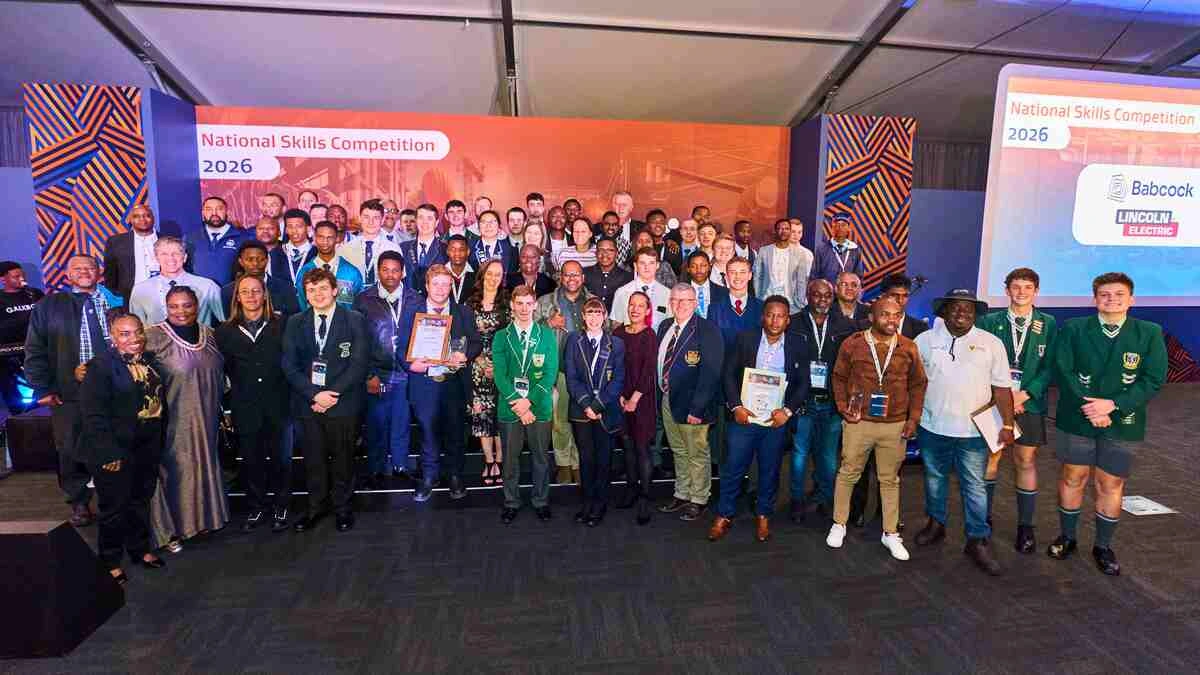
South Africa’s future is being built by skilled young hands, and technical excellence deserves the same celebration as academic success.
This was the message at the 2026 National Skills Final Competition Awards Ceremony in Johannesburg yesterday, where the country’s emerging technical talent took centre stage.
The Sasol Foundation, in partnership with Kagiso Trust, the Department of Basic Education, government and industry stakeholders, celebrated the achievements of the finalists at an evening attended by Minister of Basic Education Siviwe Gwarube, senior government and education representatives, industry leaders, educators and partners.
The national final brought together 151 learners and 77 teachers from all nine provinces who reached the 2026 national final, celebrating their achievements after more than 17,000 learners participated in qualifying rounds across the country.
Over the previous two days, Grade 10 and 11 learners and teachers competed in 11 practical, industry-relevant disciplines, putting their technical knowledge, precision, creativity, problem-solving ability and practical application of skills to the test.
“There should be no hierarchy of dignity between these pathways. A country needs doctors and engineers. But it also needs artisans, technicians, electricians, welders, fitters, machinists, mechanics, plumbers, builders and skilled operators. These skills are not second-tier careers. They are essential careers,” said Minister of Basic Education Siviwe Gwarube.
Category winners were awarded cash vouchers, tools of the trade and online courses and one lucky winner, Simthandile Mkwanazi in the Construction category was awarded a R250 000 apprenticeship from Resolution Circle.
Building a Skills Pipeline From School
For South Africa, the importance of developing these skills extends well beyond a two-day competition.
As the world of work changes through technological innovation, digitalisation, industrialisation and the transition to a greener economy, so too does the range of skills young people need to participate meaningfully in it. The challenge is not simply to create opportunities, but to ensure that young people are equipped to take advantage of them.
Building that capability needs to start early.
The National Skills Competition provides a practical example of what this can look like: identifying technical talent at school level, giving young people opportunities to test themselves against real-world challenges, exposing them to industry and creating greater visibility around technical and vocational pathways.
South Africa needs to continue rebuilding its technical skills pipeline – not as a short-term programme, but as a sustained pathway that starts at school and connects education with further learning, apprenticeships, entrepreneurship and employment.
“The competition provides young people with an opportunity to demonstrate what happens when knowledge meets practice,” said Minister Gwarube. “A textbook can explain a principle. A classroom can teach a process. But a skilled person must ultimately be able to apply that knowledge accurately, safely and efficiently.”
The competition is designed to demonstrate that technical and vocational education is not a fallback option, but a pathway into meaningful and rewarding careers. The 11 categories – spanning automotive technology, CAD, construction, digital systems, electrical power systems, engineering graphics and design, electronics, fitting and machining, plumbing, woodworking, and welding and metalwork – reflect the breadth of technical capability required in a changing economy.
For the young competitors, the national final was an opportunity not only to compete, but to build confidence, experience and a clearer understanding of where their skills can take them.
Dr Mankodi Moitse, Chief Executive Officer of Kagiso Trust, said the competition demonstrated the value of creating opportunities for young people to discover their strengths and apply what they have learned.
“Technical and vocational pathways are not alternatives to success. They are important pathways into it,” she said.
“Technical excellence requires discipline, curiosity, the willingness to learn, to make mistakes, to try again and to keep improving. These are qualities that will serve young people well, wherever their careers take them.”

Dr Mankodi Moitse CEO of Kagiso Trust
She also highlighted the role of educators in creating these opportunities.
“Skills are transferred through people. The knowledge, patience and commitment of teachers, trainers and mentors help create opportunities for others.”
Thabile Makgala, Executive Vice President: People, SHE Risk and Corporate Affairs at Sasol added, “Tonight we celebrate more than technical ability. We celebrate the confidence that comes from mastering a skill, the courage to compete, and young South Africans showing that excellence is found in practical achievement as well as academic.
“The young people we have seen over the past two days could be tomorrow’s artisans, engineers and entrepreneurs. Our responsibility is to make sure the pathway is there for them when they leave school.”
Celebrating Achievement – And The People Behind It
The awards ceremony recognised the achievements of the teachers and learners who reached the national final, with winners announced across the competition’s categories.
The competition also recognised the contribution of educators, mentors, industry partners and sponsors who supported the finalists throughout the process.
“Behind every successful learner is an educator who invested time, energy and belief,” said Makgala. “Their contribution extends far beyond the classroom. They are helping to shape the next generation of skilled South Africans.”

Thabile Makgala Executive Vice President People Risk SHE and Corporate Affairs at Sasol and Sasol foundation Trustee
The 2026 competition was supported by a growing network of partners, including the Department of Basic Education, the Department of Higher Education and Training, Kagiso Trust, Resolution Circle, Matus, Modena, ATI, John Orr Engineering School of Specialisation and other industry and category sponsors.
The organisers also acknowledged the contribution of industry partners in providing venues, expertise, equipment, judging and opportunities for young people to engage with the world of work.
The National Skills Competition began in 2018 as a partnership between the Sasol Foundation and the Free State Department of Education. Kagiso Trust joined in 2022, introducing the teacher component, with the competition expanding to five provinces in 2023 and becoming fully national in 2024.
Today, the competition brings together learners, teachers, government, education institutions and industry around a shared objective: to raise the profile of technical skills and help build a stronger pipeline of young South Africans equipped for the future.
The initiative supports South Africa’s three-stream education model and the National Development Plan 2030 target of producing 30,000 artisans a year, while providing a platform through which young technical talent can progress towards further opportunities, including international skills competitions.
For the 2026 finalists, however, the achievement is more immediate.
They have demonstrated what is possible when talent meets opportunity – and shown that South Africa is not short of ambition, ability or potential.
The task now is to continue creating the pathways that allow that potential to become opportunity.
To view the full list of winners, click here.
Logistics
Opinion Piece: Transparency is Becoming the New Competitive Advantage in Workforce Logistics

By Maureen Phiri, Director at Oxyon People Solutions
In the past, the logistics of workforce management have tended to happen behind the scenes. Clients saw the end result of staff arriving on site, projects being delivered, and operational requirements being met, but the processes that made it possible were mostly invisible. However, this approach is now beginning to change, thanks to Artificial Intelligence (AI) becoming more integrated into workforce management.
Workforce providers can now give their clients greater visibility into the processes behind staffing. This means that clients have a better understanding of workforce readiness, compliance, and operational performance, which in turn allows them to make faster, more informed decisions. For workforce providers, this means that administrative functions can become strategic assets that strengthen collaboration, build trust, and create greater value for clients.
AI is Connecting the Workforce Journey
Clients are looking for increased transparency when it comes to their outsourced staffing processes. For workforce providers to be able to do this, they need to bring together information from across the workforce lifecycle. Previously, this would have been a labour-intensive task, but AI makes it much quicker and easier to collate information from across separate systems like recruitment, onboarding, compliance, and workforce management.
Connecting these functions allows workforce providers to have a much clearer view of workforce readiness and allows them to share relevant information with clients in real time. This means that instead of waiting for reports or updates, clients can see where people are in the recruitment or onboarding process at any time. It also helps them to understand whether compliance requirements have been met, and identify any potential issues in the process.
This changes the role of workforce logistics, because the information that was previously only used to support internal operations can become a competitive advantage. With AI behind the scenes, this information can help clients plan more effectively, respond more quickly, and work more closely with their workforce partners.
Making the Back Office Visible
Take onboarding as an example. Traditionally, clients would only become involved in the process once a worker was ready to start, but using AI means that workforce providers can give their clients visibility throughout the process. This means that clients can see how onboarding is progressing as it happens, and any problems that might cause delays can be identified and dealt with early.
The same applies to compliance. With visibility throughout the recruitment processes, clients can easily see whether compliance requirements are being met, rather than only being notified when a problem occurs. This reduces risk, because issues can be handled before they can have a negative effect on client operations.
When it comes to workforce administration, the benefits are similar. Having real-time visibility into information that used to only be used internally at a workforce provider means that clients are more informed and can make better operational decisions.
More Transparency Builds Stronger Partnerships
Better visibility helps to improve reporting, but it can also change the relationship between workforce providers and their clients. If workforce providers give their clients ongoing access to more information, the whole process becomes more proactive. Problems can be identified quickly and decisions can be made faster. Added to this, both clients and workforce providers can understand the workforce journey better, as it happens.
It is important, however, to remember that responsible data management is essential. Giving clients more visibility into workforce processes does not mean providing unrestricted access to personal employee information. AI should help organisations share the information clients need to make better business decisions, but it should also be used to make sure that personal employee data is always protected.
Clients and workforce providers also need to remember that technology should never replace human judgement. AI can process information quickly and can identify potential problems, but any decisions about recruitment, onboarding, and workforce management must still be made by people who can use their experience to consider the circumstances and take responsibility for the outcome.
The Future of Workforce Logistics
AI is increasingly becoming part of workforce management, but the real value of these tools is not just in automating administrative tasks. If workforce providers can use AI to make workforce processes more transparent, they can give their clients better visibility into the information that supports operational decisions, including onboarding and compliance. This is fast becoming a competitive advantage that helps workforce providers strengthen client relationships, support better decision-making, and demonstrate the value of their expertise.

Maureen Phiri, Director at Oxyon People Solutions


Efficiency, Electrification and Intelligence Set to Shape New Era of Road Transport

Can Your Business Handle 22% More Online Orders?

CILT Conference to Explore Innovation and Cross-Border Connectivity at Automechanika Johannesburg


-

 Management3 months ago
SEO, AEO, GEO and SEO for AI: What Is the Difference for the Supply Chain Industry?
-

 Transport4 months ago
LDV T60 Max vs GWM P500 vs Isuzu D-Max vs Toyota Hilux vs Ford Ranger: Which Double-Cab Bakkie Offers the Best Value?
-

 Logistics4 months ago
DHL Group to invest around € 160 million in 2026-2027 to strengthen logistics infrastructure and support clean energy transition in France
-

 Logistics4 months ago
Top 5 Warehousing and Logistics Companies in the Western Cape by Google Review Rating
-

 Logistics4 months ago
DHL Expands Asia Pacific Data Center Logistics Capabilities to Support Growing Regional Demand
-

 Logistics4 months ago
Top 10 Warehousing and Logistics Companies in Gauteng by Google Review Rating
-

 Freight Forwarding4 months ago
The Hidden Cost of Shipping from China to South Africa — What Every SA Importer Needs to Know in 2026
-

 Logistics3 months ago
Top 4 Lift Truck Companies in Gauteng