
Press Releases
New SaferStops Association: an audacious and bold response to driver safety and wellness


SaferStops Association (SSA), an innovative organisation dedicated to transforming the landscape for commercial drivers in South Africa through comprehensive safety and driver wellness initiatives, celebrated its official launch on 13 July 2023. In its early stages, this groundbreaking public-private partnership has already gained significant traction, fuelled by a bold vision to create a more secure and supportive environment for all commercial drivers across the country.
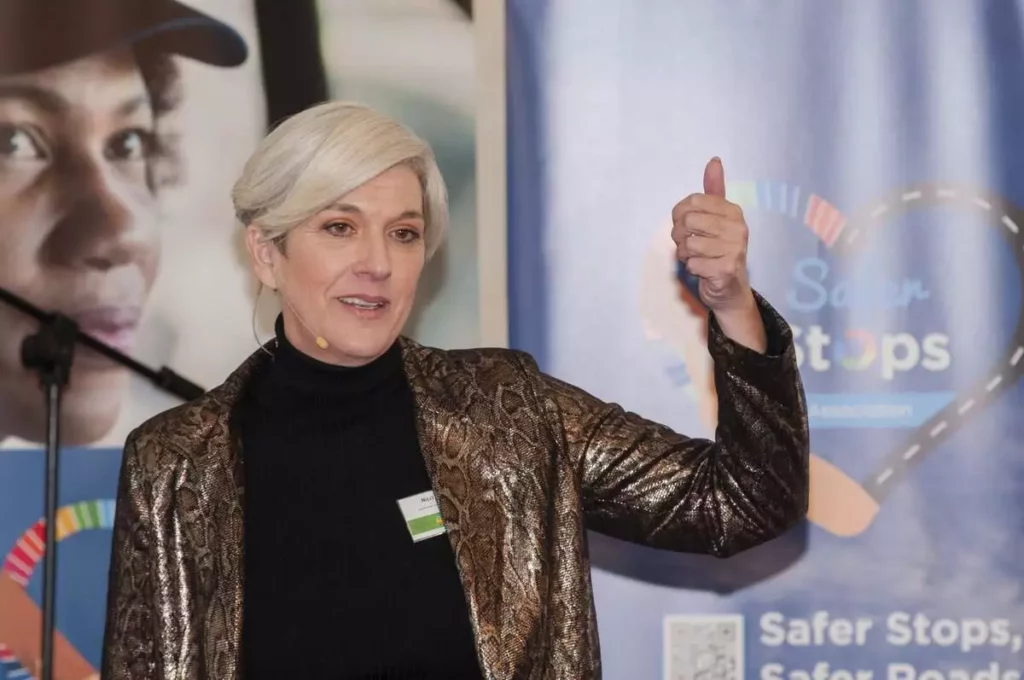
“SaferStops emerged from the gender-diversity initiatives facilitated by the Commercial Transport Academy (CTA),” explains Nicci Scott-Anderson, founder of the CTA and the SSA.
“In the process of pinpointing obstacles preventing women from embarking on long-haul trucking careers, we discerned a profound shortage of truck stops addressing female drivers’ unique requirements.
Our investigation of truck stops along principal routes revealed widespread shortcomings in catering to the enduring physical and emotional well-being of drivers – irrespective of their gender.
We also identified a pattern linking a multitude of road accidents to chronic fatigue. This exhaustion isn’t merely linked to insufficient sleep, but is frequently tied to poor nutrition, adrenal burnout, sleep apnea, and lifestyle diseases commonly affecting truck drivers.”
Key Pillars
The groundbreaking SaferStops initiative is founded on five key pillars
- Health and wellness initiatives: Providing access to tailored resources and support for maintaining physical, emotional and mental health.
- Improving truck stops infrastructure: Setting an industry benchmark for the standardisation of truck stop facilities and infrastructure, creating a space for drivers to rejuvenate
- Education and development: Offering opportunities for training to move from the class and into the cab, as drivers use new technologies to enhance their skills and knowledge
- Research and data collection: Conducting research on truck driver welfare, working conditions and industry trends, to inform policies and programmes
- Public awareness campaigns: The launching of campaigns to increase awareness of the challenges that truck drivers encounter, daily
Collaboration for success
The SaferStops initiative has received pivotal support from the US Agency for International Development (USAID), providing vital seed funding and unwavering support.
Additionally, numerous prominent companies, government departments, and leading industry associations have forged partnerships with SaferStops, demonstrating their commitment to the cause.
Notable collaborators include Hollard, Ctrack, Engen, UD Trucks, Guud, Michelin, the Department of Transport, the Gauteng Department of Roads and Transport, as well as the Road Freight Association and the National Bargaining Council for the Road Freight and Logistics Industry.
Key Activities
SaferStops has already initiated several projects aimed at improving driver well-being and safety. One such project introduces healthy meal alternatives for commercial drivers at truck stops. Additionally, the focus extends to exercise facilities, with plans to provide drivers with access to on-site gyms, allowing them to stretch, work out, and break the routine of spending up to 12 hours in a truck.
Mental health is another priority for SaferStops. “We now know that depression is one of the leading problems that truck drivers suffer from, particularly with the time they spend alone. Mental, physical and emotional health are all key, and we will be looking to address all of these requirements,” says Scott-Anderson.
Moreover, there is a dire need to provide drivers with WiFi access and entertainment facilities at truck stops, to enable them to rest and recuperate en route.
To empower drivers with valuable skills and new qualifications, SaferStops is actively developing easily accessible and user-friendly education and learning materials.
These resources will be designed to be readily accessible and easily digestible, ensuring that drivers can conveniently enhance their knowledge and acquire new qualifications.
“We know we cannot tackle this challenge alone,” continues Scott-Anderson. “As the bedrock of the logistics industry and wider economy, truck drivers perform an essential role and should be considered essential workers. Their tireless efforts power our communities, and it’s our turn to give back.
At SaferStops, our dedication is unwavering – to elevate the facilities, infrastructure, and resources that these crucial workers rely upon, with an unerring focus on fostering safer truck stops.”
Logistics
Is Your Logistics Business the One AI Recommends? A Cape Town Agency’s Numbers Say It’s Starting to Matter

A year ago, AI assistants sent this business no visitors. Now they do. For transport, logistics and supply chain companies, the way buyers shortlist carriers and freight partners is changing too.
IMS‘s work with Big Talk Entertainment shows how AI search is starting to influence how South African businesses are found. The lessons apply across the sector, from freight operators, couriers and clearing agents to warehousing, cold chain and supply chain software firms.
Between February and July 2026, Big Talk Entertainment recorded 28 website sessions from AI assistants such as ChatGPT, Gemini and Perplexity. Over the same period in 2025, Google Analytics 4 recorded none. The Cape Town entertainment agency worked with Johannesburg-based digital agency IMS to make its website easier for search engines and generative AI tools to find, understand and cite.
The numbers are still small, and IMS is candid about that. “The direction is what matters,” says IMS’s Chief Disruptor, Francois Vorster. “A way of finding customers that did not exist a year ago now does.”
Over the same six months, new visitors from Google search rose 67%, and people typing the website’s address directly into their browser, often a sign that someone remembers a brand, rose 87%.
Why This Matters for Logistics
Big Talk is not a logistics business, but its corporate buyers behave like yours. They research several suppliers before they make contact, and in logistics a poor choice means late deliveries and damaged stock. More of that research now starts with a question put to an AI tool, such as “Which freight forwarders handle cross-border shipments to Zambia?” or “Who offers warehousing near the Durban port?”
“Choosing a logistics, transport or supply chain partner is a high-stakes decision, so buyers research thoroughly before they request a quote, and more of that research now starts in an AI tool and not a Google search,” says Vorster. “We can’t say for certain how much of the improvement came from traditional search work and how much from the AI-focused work. What we can say is that AI tools have become a measurable new source of visitors for a business that had none a year ago.”
What IMS Did
IMS combined traditional search work with making the business easier for AI tools to find and recommend: improving the website’s technical foundations, rewriting pages to answer the questions customers ask, and keeping the business’s details consistent everywhere AI tools look.
For a logistics business, that means clearly explained services, current coverage areas and routes, fleet and capabilities, licences and certifications, and answers to common shipper questions.
“A few years ago, nobody asked ChatGPT to recommend a band for their wedding. Now many people do,” says Deon Schlebusch, Managing Director of Big Talk Entertainment. “We are not walking away from the channels that have always worked for us, but we’d be foolish to ignore a new one that’s starting to send us business leads.”
A Word of Caution
The results come from Big Talk’s own analytics, comparing 1 February to 31 July 2026 with the same period in 2025. Because traditional and AI-focused work ran together, the growth cannot be credited to the AI work alone, and any link between AI recommendations and direct visits cannot be proven from the data. “We would rather show what we can actually measure than overclaim,” says Vorster.
Logistics businesses should also make sure claims about coverage, transit times, licences and safety records are accurate and verifiable, because buyers rely on what AI tools tell them.
What is GEO?
Generative Engine Optimisation, or GEO, is the practice of making a business easier for AI tools to find and recommend. Where SEO is about ranking on Google, GEO is about being the answer an AI tool gives.
The full case study is available at https://imsolutions.co.za/news/big-talk-entertainment/

Francois Vorster, IMS Chief Disruptor

Deon Schlebusch, Managing Director of Big Talk Entertainment
Logistics
Opinion Piece: Open Access to Rail Can Be a Game-Changer for SA, But Only if Infrastructure Investment Accelerates

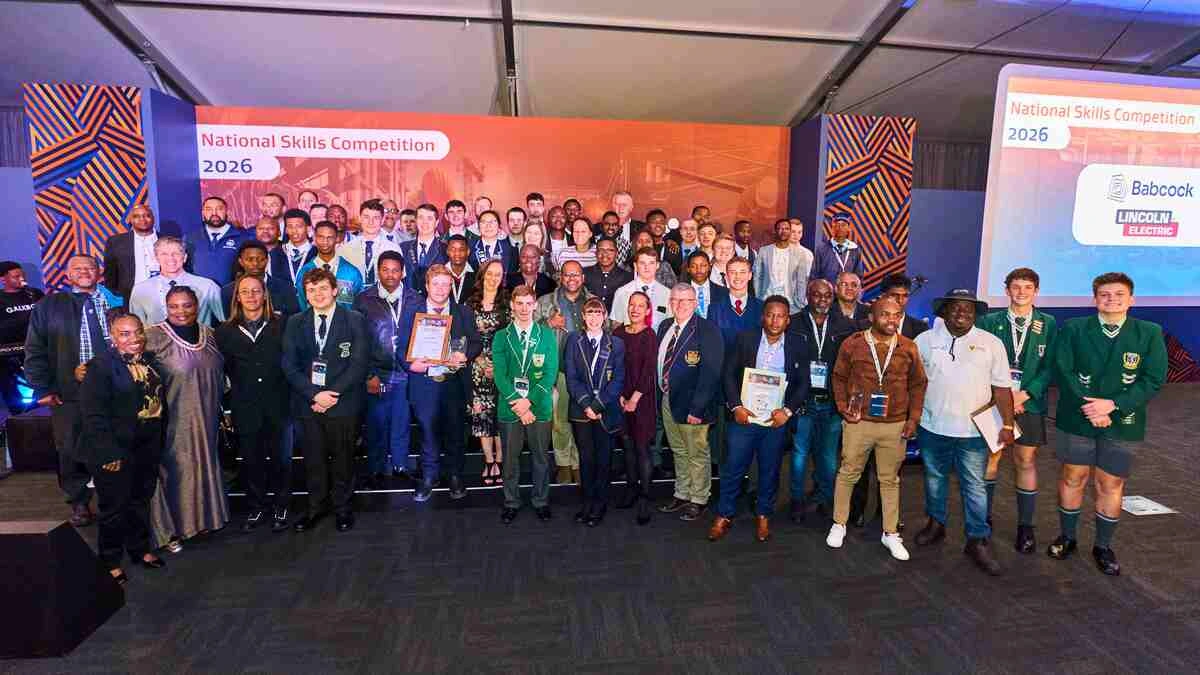
South Africa’s future is being built by skilled young hands, and technical excellence deserves the same celebration as academic success.
This was the message at the 2026 National Skills Final Competition Awards Ceremony in Johannesburg yesterday, where the country’s emerging technical talent took centre stage.
The Sasol Foundation, in partnership with Kagiso Trust, the Department of Basic Education, government and industry stakeholders, celebrated the achievements of the finalists at an evening attended by Minister of Basic Education Siviwe Gwarube, senior government and education representatives, industry leaders, educators and partners.
The national final brought together 151 learners and 77 teachers from all nine provinces who reached the 2026 national final, celebrating their achievements after more than 17,000 learners participated in qualifying rounds across the country.
Over the previous two days, Grade 10 and 11 learners and teachers competed in 11 practical, industry-relevant disciplines, putting their technical knowledge, precision, creativity, problem-solving ability and practical application of skills to the test.
“There should be no hierarchy of dignity between these pathways. A country needs doctors and engineers. But it also needs artisans, technicians, electricians, welders, fitters, machinists, mechanics, plumbers, builders and skilled operators. These skills are not second-tier careers. They are essential careers,” said Minister of Basic Education Siviwe Gwarube.
Category winners were awarded cash vouchers, tools of the trade and online courses and one lucky winner, Simthandile Mkwanazi in the Construction category was awarded a R250 000 apprenticeship from Resolution Circle.
Building a Skills Pipeline From School
For South Africa, the importance of developing these skills extends well beyond a two-day competition.
As the world of work changes through technological innovation, digitalisation, industrialisation and the transition to a greener economy, so too does the range of skills young people need to participate meaningfully in it. The challenge is not simply to create opportunities, but to ensure that young people are equipped to take advantage of them.
Building that capability needs to start early.
The National Skills Competition provides a practical example of what this can look like: identifying technical talent at school level, giving young people opportunities to test themselves against real-world challenges, exposing them to industry and creating greater visibility around technical and vocational pathways.
South Africa needs to continue rebuilding its technical skills pipeline – not as a short-term programme, but as a sustained pathway that starts at school and connects education with further learning, apprenticeships, entrepreneurship and employment.
“The competition provides young people with an opportunity to demonstrate what happens when knowledge meets practice,” said Minister Gwarube. “A textbook can explain a principle. A classroom can teach a process. But a skilled person must ultimately be able to apply that knowledge accurately, safely and efficiently.”
The competition is designed to demonstrate that technical and vocational education is not a fallback option, but a pathway into meaningful and rewarding careers. The 11 categories – spanning automotive technology, CAD, construction, digital systems, electrical power systems, engineering graphics and design, electronics, fitting and machining, plumbing, woodworking, and welding and metalwork – reflect the breadth of technical capability required in a changing economy.
For the young competitors, the national final was an opportunity not only to compete, but to build confidence, experience and a clearer understanding of where their skills can take them.
Dr Mankodi Moitse, Chief Executive Officer of Kagiso Trust, said the competition demonstrated the value of creating opportunities for young people to discover their strengths and apply what they have learned.
“Technical and vocational pathways are not alternatives to success. They are important pathways into it,” she said.
“Technical excellence requires discipline, curiosity, the willingness to learn, to make mistakes, to try again and to keep improving. These are qualities that will serve young people well, wherever their careers take them.”

Dr Mankodi Moitse CEO of Kagiso Trust
She also highlighted the role of educators in creating these opportunities.
“Skills are transferred through people. The knowledge, patience and commitment of teachers, trainers and mentors help create opportunities for others.”
Thabile Makgala, Executive Vice President: People, SHE Risk and Corporate Affairs at Sasol added, “Tonight we celebrate more than technical ability. We celebrate the confidence that comes from mastering a skill, the courage to compete, and young South Africans showing that excellence is found in practical achievement as well as academic.
“The young people we have seen over the past two days could be tomorrow’s artisans, engineers and entrepreneurs. Our responsibility is to make sure the pathway is there for them when they leave school.”
Celebrating Achievement – And The People Behind It
The awards ceremony recognised the achievements of the teachers and learners who reached the national final, with winners announced across the competition’s categories.
The competition also recognised the contribution of educators, mentors, industry partners and sponsors who supported the finalists throughout the process.
“Behind every successful learner is an educator who invested time, energy and belief,” said Makgala. “Their contribution extends far beyond the classroom. They are helping to shape the next generation of skilled South Africans.”

Thabile Makgala Executive Vice President People Risk SHE and Corporate Affairs at Sasol and Sasol foundation Trustee
The 2026 competition was supported by a growing network of partners, including the Department of Basic Education, the Department of Higher Education and Training, Kagiso Trust, Resolution Circle, Matus, Modena, ATI, John Orr Engineering School of Specialisation and other industry and category sponsors.
The organisers also acknowledged the contribution of industry partners in providing venues, expertise, equipment, judging and opportunities for young people to engage with the world of work.
The National Skills Competition began in 2018 as a partnership between the Sasol Foundation and the Free State Department of Education. Kagiso Trust joined in 2022, introducing the teacher component, with the competition expanding to five provinces in 2023 and becoming fully national in 2024.
Today, the competition brings together learners, teachers, government, education institutions and industry around a shared objective: to raise the profile of technical skills and help build a stronger pipeline of young South Africans equipped for the future.
The initiative supports South Africa’s three-stream education model and the National Development Plan 2030 target of producing 30,000 artisans a year, while providing a platform through which young technical talent can progress towards further opportunities, including international skills competitions.
For the 2026 finalists, however, the achievement is more immediate.
They have demonstrated what is possible when talent meets opportunity – and shown that South Africa is not short of ambition, ability or potential.
The task now is to continue creating the pathways that allow that potential to become opportunity.
To view the full list of winners, click here.

Is Your Logistics Business the One AI Recommends? A Cape Town Agency’s Numbers Say It’s Starting to Matter

Opinion Piece: Open Access to Rail Can Be a Game-Changer for SA, But Only if Infrastructure Investment Accelerates

South Africa’s Technical Talent Takes Centre Stage at National Skills Competition


-

 Management3 months ago
SEO, AEO, GEO and SEO for AI: What Is the Difference for the Supply Chain Industry?
-

 Transport4 months ago
LDV T60 Max vs GWM P500 vs Isuzu D-Max vs Toyota Hilux vs Ford Ranger: Which Double-Cab Bakkie Offers the Best Value?
-

 Logistics4 months ago
DHL Group to invest around € 160 million in 2026-2027 to strengthen logistics infrastructure and support clean energy transition in France
-

 Logistics4 months ago
DHL Expands Asia Pacific Data Center Logistics Capabilities to Support Growing Regional Demand
-

 Logistics3 months ago
Top 5 Warehousing and Logistics Companies in the Western Cape by Google Review Rating
-

 Logistics4 months ago
Top 10 Warehousing and Logistics Companies in Gauteng by Google Review Rating
-

 Freight Forwarding4 months ago
The Hidden Cost of Shipping from China to South Africa — What Every SA Importer Needs to Know in 2026
-

 Logistics3 months ago
Top 4 Lift Truck Companies in Gauteng